How boards learned to fly
The short version
A board, something to push it, and whatever touches the water. For most of history the three came as one package. Since the 1960s they have been pulled apart and recombined, and once the hydrofoil lifted the hull out of the water, almost any push was enough.
85 dated events · 148 sources, numbered in brackets · every date says what it marks: a prototype, a patent, a first sale or the year it caught on
One family tree
Every sport in the atlas on one time line, laned by what pushes the rider. Follow a line back and it ends at surfing; follow the dotted drops and you see the hydrofoil arriving, sport by sport, mostly after 2000.
Hollow dot: rides on a fin · filled dot: rides on a foil · solid line: grew out of · dashed: borrowed from · dotted drop: the hydrofoil arrives. Hover a sport to follow its line; click to read its story.
Why the foil changed everything
A planing board drags its whole bottom through the water. On a foil the hull flies, and only a mast and two small wings stay wet. That is why a paddle stroke or a hand-held wing, too weak to plane a board, can keep one flying.
Slow: the hull pushes water
Below takeoff speed this 52 L board sinks under its rider like any hull; the foil underneath only adds drag.
- In the water
- 0.85 m²
- Carried by the foil
- 0 %
- Drag, schematic
F-One Rocket Wing 2026 52 L: side line traced from the brand’s photos; rider (1.78 m) and board at the same true scale, back foot over the mast. The foil is a typical wing-foil set, drawn schematically: 85 cm mast, ~1300 cm² front wing riding 25 cm deep. Takeoff is set at 13 km/h; one measured case is 7.4 kn (14 km/h) for an 85 kg rider on 1150 cm². Lift ∝ speed² is physics; the drag curve shows the shape riders feel, not measured values.
Every push, twice
Rows are what pushes the rider, columns what touches the water. Nearly every cell is a sport. Press play: the left column fills over a century, the right one in about twenty years.
In 2026: 12 of 12 combinations ridden, 7 of them on a foil.
| pushed by | On the watera fin, the hull planes | Above ita hydrofoil, the hull flies |
|---|---|---|
| Wave | Surfing1779 | Surf foil1996 |
| Paddle | Stand-up paddle1940 | SUP & downwind foil2016 |
| Sail | Windsurfing1964 | Windfoil1979 |
| Kite | Kitesurfing1984 | Kitefoil2004 |
| Wing | Hand sail1981It worked, but a wing held in the hands could barely pull a planing board. It waited almost 40 years for the foil. | Wingfoil2019 |
| Parawing | —Nobody. A parawing is too small to plane a board; it only works because the foil needs so little. | Parawing2024 |
| Motor | —Motorised surfboards exist, but they are outside the atlas. | eFoil2017 |
01 · adds the board
A board and a wave
…–1957
For centuries the only engine was the ocean. Boards grew lighter and gained a fin, and the waves stayed the only power. On the side, engineers were already lifting boat hulls out of the water on underwater wings. Nobody would stand on one for another fifty years.
- 1779first recorded
First European written account of Hawaiian surfing
Lieutenant James King, on Cook's third voyage, described Hawaiians at Kealakekua Bay riding swells prone on oval wooden planks in early 1779. William Anderson's 1777 Tahiti note on canoe-surfing is earlier but is not board-riding.
correctedDoc lists surfing only as 'Pre-modern'. 1779 is the first written European record, not the start of surfing, which is far older in Polynesia.
- 1830approximate
Olo, alaia and paipo: the Hawaiian board classes
Pre-contact Hawaii had three main board types. The olo was a very long, thick, finless board tied to the ali'i (chiefs). The alaia was a thin mid-length board anyone could ride. The paipo was a short board ridden prone. The best-known surviving olo is the one credited to high chief Abner Paki, ridden at Waikiki in the 1830s and now in the Bishop Museum.
correctedWood is contested. EOS says olos were usually wiliwili, but Blake's captions describe Paki's olo as koa, and the museum has no surviving wiliwili olo.
- 1898–1905first prototype
Forlanini starts ladder-foil experiments and files patents
Enrico Forlanini began hydrofoil work around 1898 using stacked 'ladder' foils: as speed rises, fewer rungs stay submerged. His patents came later: Italy 1904, and Britain and the US in 1905 (US 1,112,405, filed April 1905, granted 1914).
correctedThe doc's '1898 patent' is not supported by any patent found. 1898 is when the work began. The earliest patents found are Italian (1904) and British/US (1905); the US grant came in 1914.
- 1906dated
Forlanini's Idroplano flies on Lake Maggiore
Forlanini's full-size hydrofoil boat, driven by air propellers, lifted clear of the water in trials on Lake Maggiore. Reported top speeds vary from about 27 kn to about 68–70 km/h.
- 1908first recorded
Bell and Baldwin begin hydrofoil work at Baddeck
Alexander Graham Bell, Mabel Bell and engineer F.W. 'Casey' Baldwin started hydrofoil experiments at Beinn Bhreagh, Baddeck, Nova Scotia, in 1908. The work paused and resumed several times before the HD series.
- 1912dated
Duke Kahanamoku wins Olympic 100 m freestyle
Duke Kahanamoku won the 100 m freestyle at Stockholm (final 10 July 1912). The fame that followed made him surfing's international ambassador.
correctedNot in doc. Bishop Museum blog gives 6 July 1912, which is the date of the heats, not the final.
- 1914–1915dated
Duke demonstrates board surfing in Australia
At Freshwater (Sydney) on 24 December 1914, Duke rode a sugar-pine board he had shaped locally, with a second public show on 10 January 1915. The board is still displayed at Freshwater SLSC.
correctedSome sources give 10 January 1915 as the first demonstration. Contemporary press puts the first one on 24 Dec 1914.
- 1918first prototype
HD-4 launched and trialled
The 60 ft HD-4 hydrodrome began trials in October 1918, first with two 250 hp Renault engines. In July 1919 these were replaced with Liberty V-12s.
- 1919dated
HD-4 sets the world water speed record (9 Sept 1919)
On 9 September 1919 on Bras d'Or Lake, the HD-4 reached 114 km/h (70.86 mph), a world marine speed record. Gar Wood's Miss America beat it in 1920. The original hull and a replica are shown at the Alexander Graham Bell National Historic Site.
correctedThe doc's '≈114 km/h' is right; the exact date is 9 Sept 1919. Lift's claim that the record 'stood for two decades' is wrong, since Gar Wood beat it in 1920. The Musée de la Plaisance gives '70.86 knots' (should be mph), and USA Water Ski gives '60 knots'.
- 1926–1929first prototype
Tom Blake's drilled and hollow boards
Blake studied the Bishop Museum olos, then from 1926 lightened a solid board by drilling it and skinning it with veneer. By 1929 he had a 16 ft chambered paddleboard. These led to the 'cigar box' hollow board that made boards far lighter.
- 1931–1932dated
Blake patents the hollow 'Water Sled'
Blake filed US patent 1,872,230 on 18 April 1931 and it was granted on 16 August 1932. Several licensed makers produced his hollow surf and paddle boards from 1932 into the early 1950s.
- 1932dated
First mainland-to-Catalina paddleboard race
Blake won the first Catalina crossing on his chambered hollow board, showing that hollow boards suited long-distance paddling. This is the root of prone distance racing and, later, open-ocean SUP.
- 1935first recorded
Blake adds a fixed fin (skeg)
In 1935 Blake fixed a small keel-like fin to the tail of his board. This gave directional hold and turning bite that finless boards lacked. It is his most lasting design contribution.
- 1940–1960approximate
Waikiki 'beach boy surfing'
Waikiki instructors, notably the Ah Choy family (John 'Pops' and sons Bobby and Leroy) along with Duke Kahanamoku, stood on big boards with canoe paddles. This let them watch students, spot sets and carry cameras. It is the direct ancestor of SUP.
correctedSources start it anywhere from the 1940s (Wikipedia, Hawaiian Paddle Sports) to the 1950s (SUPboarder). Photographic evidence is limited.
- 1947–1949first prototype
Bob Simmons: hydrodynamic planing-hull boards
After the war, Simmons applied planing-hull theory (Lindsay Lord) and new materials: balsa, polystyrene foam sandwiches, fibreglass and polyester resin. His 1949 'Spoon' was a light 10 ft balsa-and-glass board.
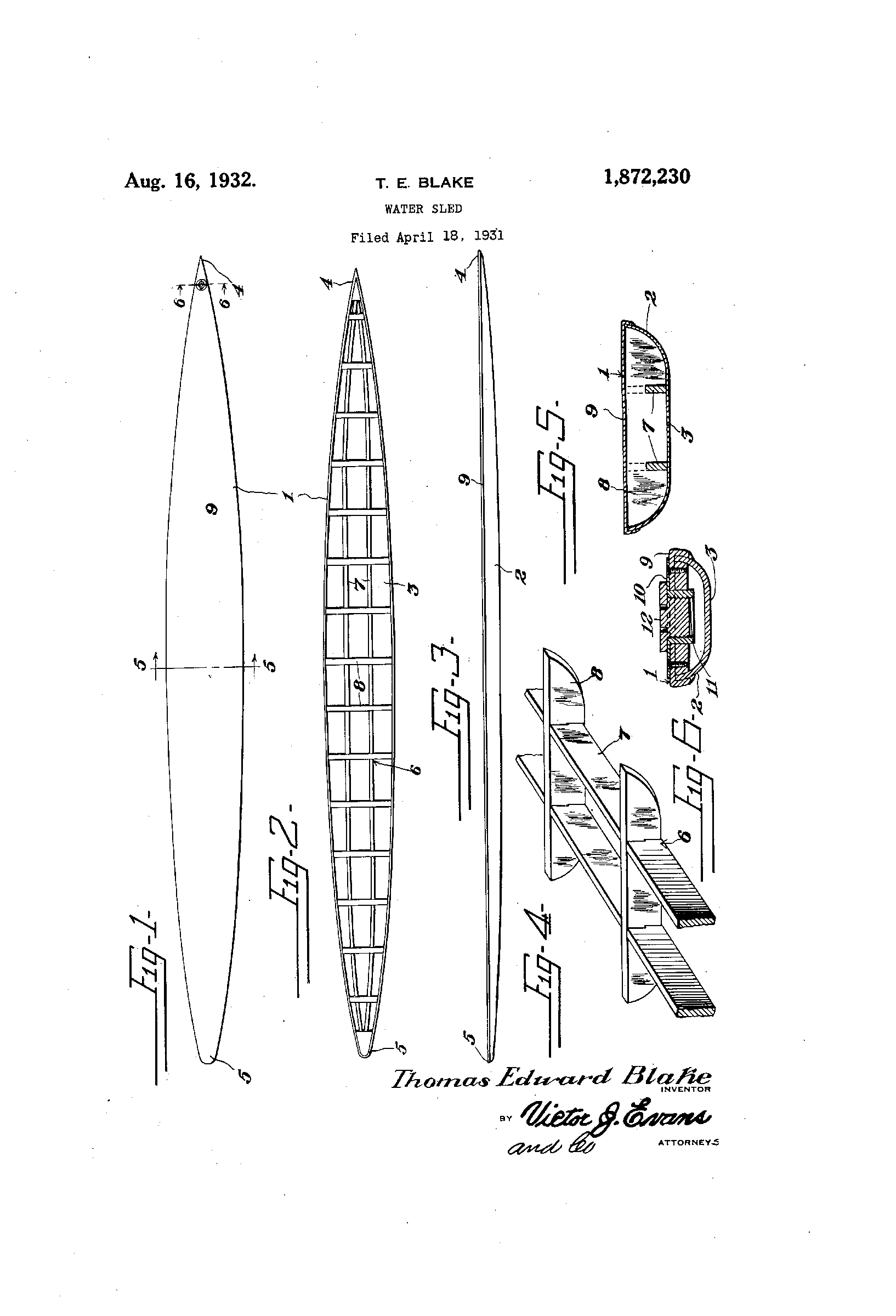
Tom Blake’s “water sled”, 1931
Duke Kahanamoku’s solid pine board of 1914 weighed around 36 kg. Blake built boards hollow, a skin over ribs, and patented the idea in 1931. Licensed makers turned out his hollow surf and paddle boards for twenty years. The outline is traced from his figure 1, the pointed tail at the top.
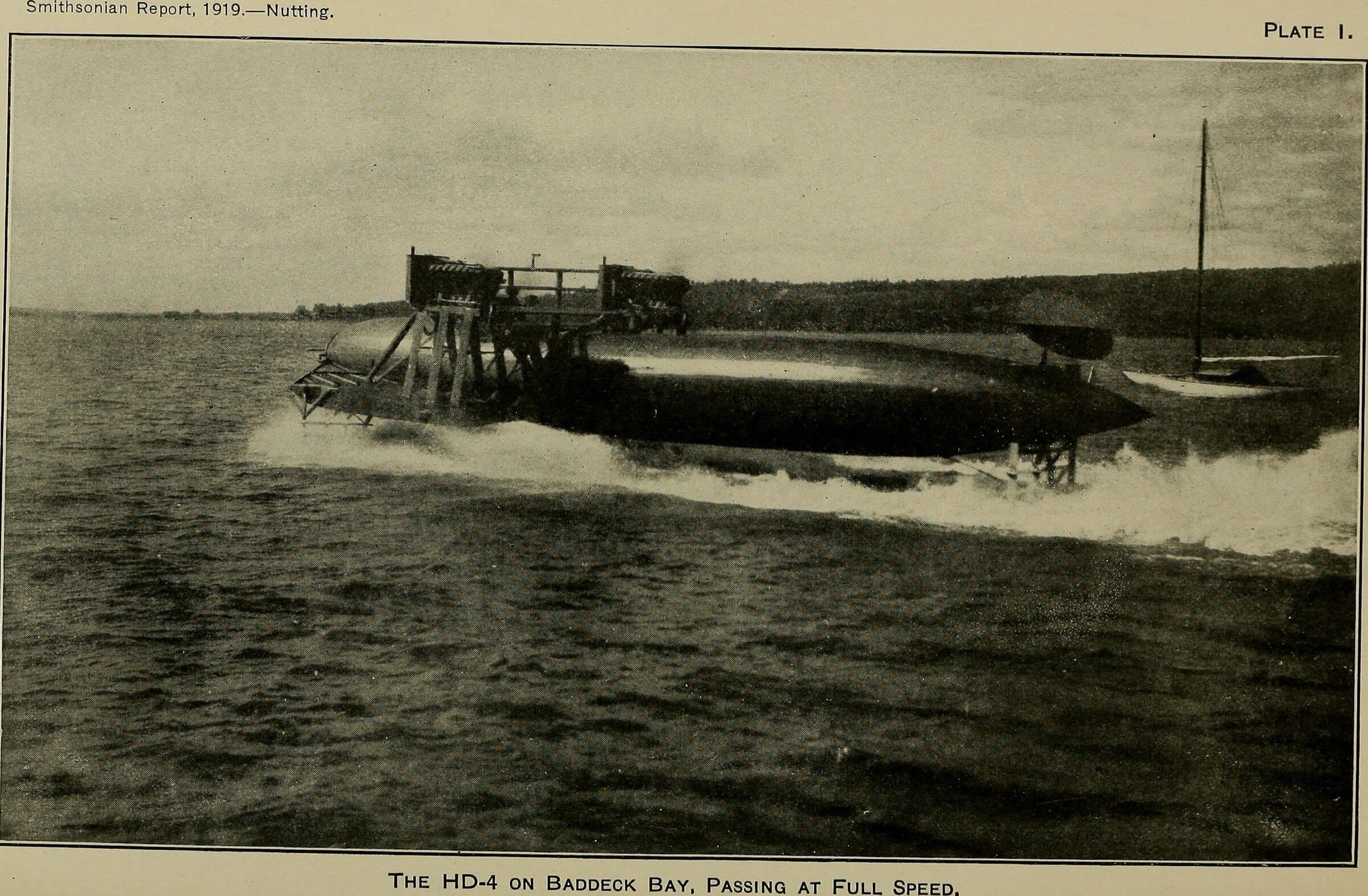
Lift, thirty years before anyone stood on it
Alexander Graham Bell and Casey Baldwin’s HD-4 rode on ladders of underwater wings. On 9 September 1919 it reached 114 km/h on Bras d’Or Lake, a world record on water. The principle every foil board uses was already there: wings under the surface, hull in the air.
02 · adds wind, fixed to the board
A sail on a surfboard
1958–1983
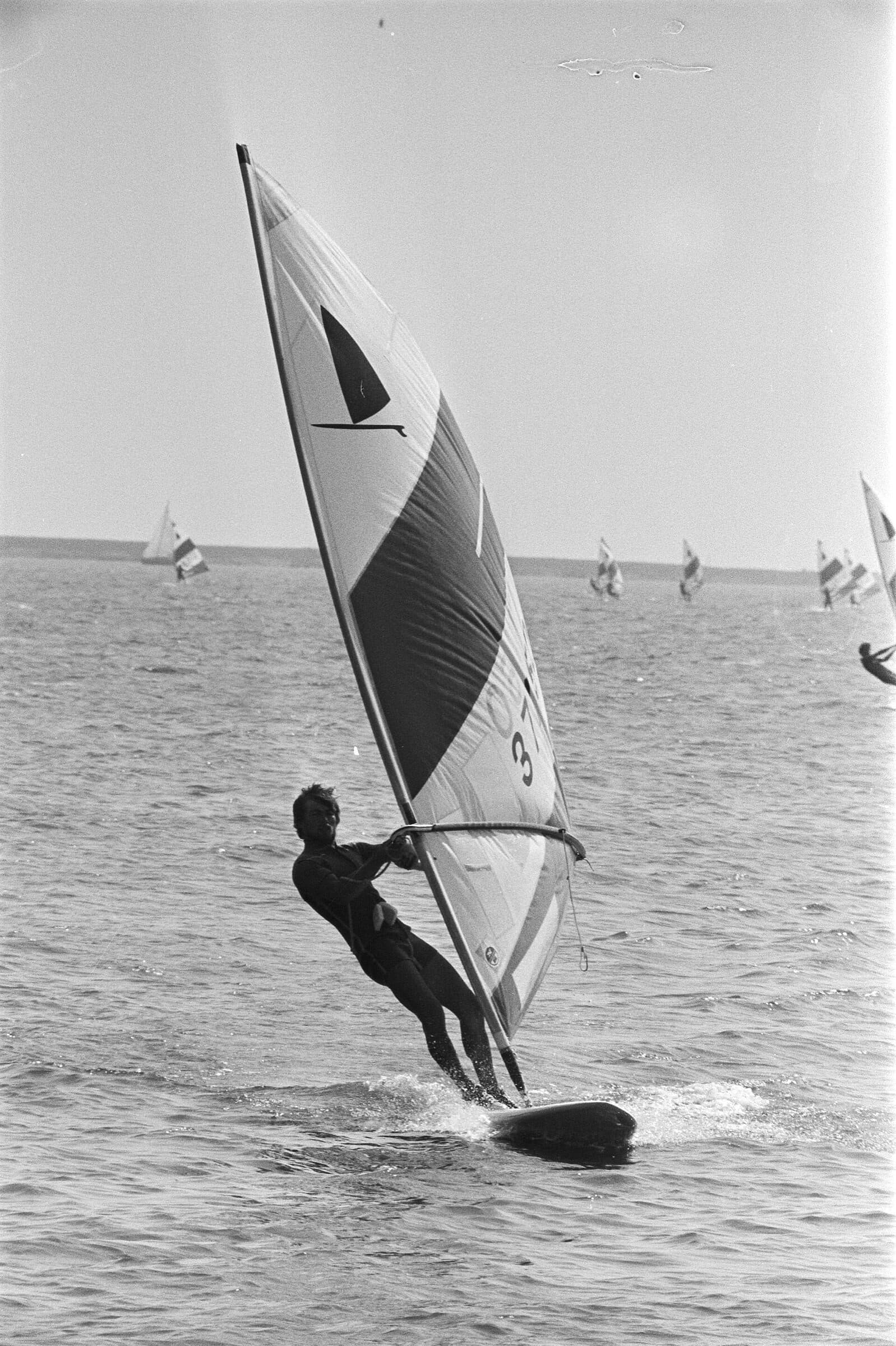
Put a free-standing rig on a board, let the rider hold it, and the board no longer needs a wave. Windsurfing turned a coastal craft into a flat-water sport. It also made the pattern every later sport copied: board, wind and a rider who steers by moving the rig. By 1981 inventors were already holding the rig free in their hands, and a few had bolted foils under sailboards.
- 1958first prototype
Peter Chilvers' sailboard (Hayling Island)
Aged 12, Chilvers built and sailed a board with a free, hand-held rig on Hayling Island. UK courts later held that it contained every element of the modern windsurfer.
- 1958–1961first on sale
Polyurethane foam blanks (Hobie Alter and Grubby Clark)
Alter and Gordon Clark reached full production of blown polyurethane blanks in mid-1958, and foam plus fibreglass replaced balsa. Clark set up Clark Foam in 1961. It dominated blank supply until it suddenly closed on 5 December 2005.
correctedWho was first to market is disputed: Dave Sweet may have sold foam boards about a year earlier. Polystyrene foam boards existed from 1950-51.
- 1963–1965first on sale
Woodward's water-ski hydrofoil: Dynaflite
Aeronautical engineer Walter Woodward built the first water-ski hydrofoil in the early 1960s, and Frazier Sinclair was its first test pilot. With Lucas Emmanuel he set up Cosmo (later Custom) Dynamics, which sold it as the Dynaflite from 1963. The patent (priority March 1963) was granted in 1965 and shows a delta strut carrying a front foil and rear stabiliser.
- 1964–1965first prototype
Newman Darby's sailboard and Popular Science article
Darby had the idea in 1948 and built his free-sail sailboard in 1964. Naomi Darby was photographed sailing it that summer. He described 'sailboarding' in Popular Science in August 1965. His rig used a rope universal joint and a kite-shaped sail without a wishbone. Only a few hundred were sold.
correctedDoc: '1963-64 Darby develops sailboard'. The first sail is documented in summer 1964 and the publication is August 1965 (not 1964). The Windsurfer Class site says 1963.
- 1967first prototype
Drake and Schweitzer's first free-sail board
Jim Drake and Hoyle Schweitzer built the prototype in early 1967 and first sailed it in May 1967 at Marina del Rey. An uphaul and skeg were added within weeks. It combined a universal joint with a wishbone boom.
correctedDoc credits Drake alone. It was a joint development with Schweitzer. The exact day is disputed: Drake's own interview says 23 May 1967, the IWA says 21 May 1967.
- 1967–1970approximate
The shortboard revolution
From 1967 (McTavish's vee-bottom 'Plastic Machine', Greenough's flex fin and kneeboards, and the Honolua Bay sessions in December 1967), boards shrank fast. By about 1970 the typical board had gone from about 9'6" and 26 lb to about 6'6" and 10 lb.
correctedUsually dated 1967, but it is a 1967-70 process rather than a single year.
- 1968–1970dated
US patent 3,487,800 (Windsurfer)
The patent was filed on 27 March 1968 and granted on 6 January 1970. It claimed a universally jointed, unstayed mast with curved booms. It was reissued as RE31,167 on 8 March 1983 and expired in the late 1980s.
correctedDoc gives '1968: Drake/Schweitzer patent'. 1968 is the filing date; the grant was 6 Jan 1970. Also, The Sailing Museum page cited in the doc wrongly says 1966, and the Windsurfing Museum says June 1970.
- 1968–1973approximate
Windsurfing International and the 'Windsurfer' name
Windsurfing International was set up in 1968. The name 'Windsurfer' (after 'Skate' and 'Baja Board') was coined around late 1967-68. It was registered as a US trademark around 1973, but a US district court ruled 'windsurfer' generic in January 1987.
correctedDoc gives 1969 for the name. Drake dates the coinage to late 1967/1968, and the company dates to 1968. The 1973 registration year comes from search snippets.
- 1970–1973first recorded
First foils under a sailboard (speed trials)
Gary Seaman, an engineer at Windsurfing International, reportedly fitted foils under a board for the Pacific Multihull Association speed trials at Hurricane Gulch between 1970 and 1973.
- 1970–1977first on sale
The surf leash
In Santa Cruz in 1970, Pat O'Neill and Roger Adams tied surgical tubing from board to rider. By 1971 it was fixed near the fin. Urethane cords from about 1977 gave the leash its modern form. Earlier experiments (Blake in the 1930s, a French design in 1958) never caught on.
- 1970first on sale
Series production of the Windsurfer
Windsurfing International started manufacturing polyethylene Windsurfers in 1970 (first production board reportedly March 1970). By 1975 about 80,000 had been sold worldwide.
- 1972dated
Ten Cate licence: Windsurfer boom in Europe
The Dutch textile group Ten Cate took a licence in 1972 to build and sell Windsurfers in Europe. Europe then became the sport's biggest market. The IYRU recognised the class in 1973, and the first world championship was held that year.
- 1974–1975first prototype
The windsurfing harness
In Kailua, Hawaii, around 1974, Ken Kleid (idea) and Pat Love (build) made the first working harness line/hook vest. Mike Horgan and Larry Stanley added the spreader bar in 1975. Sailors could now hang their weight from the boom.
- 1977first prototype
Footstraps
Larry Stanley and the 'Kailua kids' fitted footstraps to Windsurfers around 1977. Riders could stay on the board through jumps and high-speed chop, which led to wave sailing.
- 1979–1980disputed
Early windsurf hydrofoils: Speer, Nederpelt/Mistral
The Prague windsurfing museum names John Speer (USA) as probably the first to put a hydrofoil on a windsurfer, in 1979. Dutch pioneer Joop Nederpelt's foil for Mistral boards followed around 1980, with Peter Harken in 1985 and Rich Miller in 1997.
correctedThe doc calls Nederpelt's 1979 foil the first windsurf foil. The museum puts Speer first (1979) and Nederpelt/Mistral in 1980, and Seaman may have foiled a sailboard as early as 1970–73.
- 1980–1981first prototype
Simon Anderson's Thruster (three-fin)
Anderson built the first three-fin 'Thruster' in October 1980. He had been inspired by a Frank Williams twin-fin with a small stabiliser fin. He won Bells Beach, the Coke Surfabout and the Pipeline Masters in 1981, and by the mid-1980s the thruster was the standard fin setup. He did not patent it.
- 1981–1986first prototype
Roland Le Bail's Bird Sail
The Breton windsurfer Roland Le Bail developed a gull-wing, boomed sail inspired by birds. He patented it from 1981 (US 4,563,969, granted 14 Jan 1986) and tested it on funboards, roller skates and skis around 1982.
- 1981–1987first prototype
Jim Drake's handheld twin-wing 'Hand Sail'
In 1981 Jim Drake, with SURF's Uli Stanciu, built a free, hand-held dihedral wing with a central boom, not attached to the board. A German priority was filed on 13 Oct 1981, and US 4,651,665 was granted on 24 Mar 1987. It was the conceptual grandparent of the wing, and inspired Finland's Kitewing.
correctedThe doc's handheld-wing prehistory lists the Bird Sail and the Wind Weapon but misses this one, the first wing held free in the hands (1981).
- 1981–1984first on sale
Funboards, shorter boards and fully battened sails
Fully battened sails (1978) were followed by the 'funboard' concept and retractable daggerboards (1981), then camber inducers (1983). Boards got shorter and specialised for high wind and waves.
- 1982–1984dated
UK courts void the Windsurfer patent (Chilvers prior art)
On 7 April 1982, Whitford J (Patents Court) dismissed Windsurfing International's case against Tabur Marine and revoked GB 1,258,317, relying on Chilvers' 1958 board and a prior publication. The Court of Appeal upheld this on 31 January 1984 ([1985] RPC 59), creating the 'Windsurfing' obviousness test.
correctedOften cited only as '1985' (the report year). The judgments are 1982 (first instance) and 1984 (appeal).
- 1983–1985disputed
Hydrofoil kneeboard
Mike Murphy co-invented the kneeboard in 1972. Mounting kneeboards on hydrofoils came later, in first-hand accounts around 1983–85, at Murphy's Colorado River ski school with Bob Woolley. This led directly to the sit-down foil.
correctedThe doc's '1973 hydrofoil kneeboard' (Lift: 'Murphy and Bud Holst, 1973') mixes up the kneeboard itself (1972) with the foil kneeboard. Murphy's and Klarich's first-hand accounts put the foil kneeboard at 1983–85. Wikipedia says 1972, and no source found mentions Bud Holst.
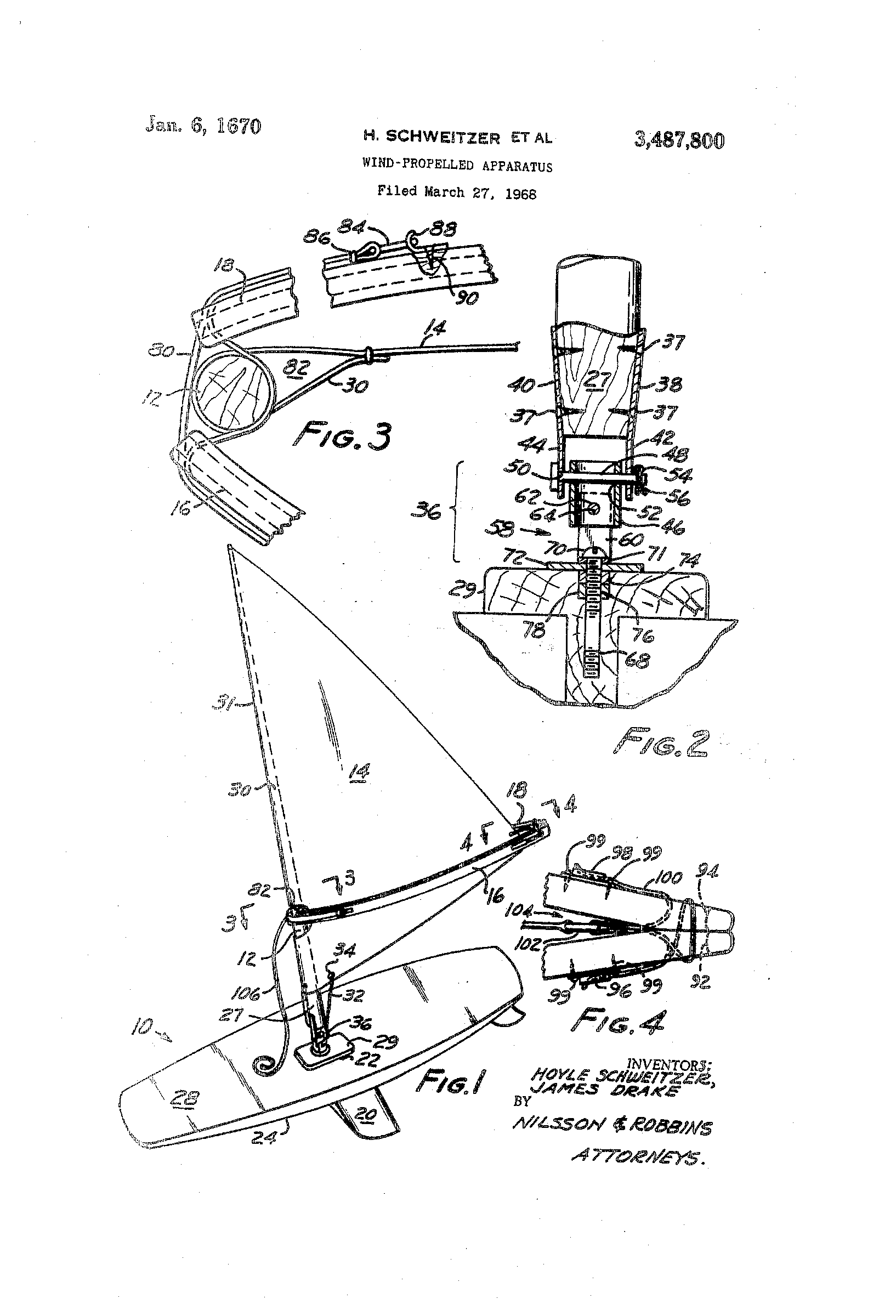
Wind-propelled apparatus, 1968
Drake and Schweitzer’s patent is one sheet: a board, and a rig on a universal joint with curved booms. The rider holds the rig up and steers by tilting it; there is no rudder. Filed in March 1968, granted in January 1970, it set the pattern kites and wings would copy.


03 · adds propulsion leaves the board
Wind on a string, wind in the hands
1984–1999
Kites moved the engine up the lines and off the board, and inflatable leading edges let them relaunch from the water. The same years brought wings on hinged masts and the first production foil you could sit on behind a boat. Maui's tow-in surfers pulled the seat off that foil and stood up.
- 1984–1987dated
Legaignoux brothers' inflatable kite patent
Bruno and Dominique Legaignoux tested kite-powered craft from May 1984 (Dakar) and filed a French patent on 16 November 1984 (FR8417701) for a wing with an inflatable leading edge and struts. The US equivalent 4,708,078 was filed in 1985 and granted on 24 November 1987. The design floats and can relaunch from water.
correctedMany sites say it was 'patented November 1987', which is the US grant date. The invention and priority date are 16 Nov 1984. Surf-magazin's '1997' is also wrong.
- 1984dated
Windsurfing debuts at the Los Angeles Olympics
Men's boardsailing was held at Long Beach from 31 July to 8 August 1984 on the Windglider one-design, with 38 sailors. Stephan van den Berg (NED) won. The Windsurfer appeared only as a demonstration board.
correctedThe doc's '1984 Olympic debut' is right, but the Olympic board was the Windglider, not the Windsurfer. The Sailing Museum page implies the Windsurfer.
- 1984–1986disputed
First sit-down hydrofoil prototype
Bob Woolley built and rode the first sit-down hydrofoil. Wikipedia dates it to 1984; Klarich's first-hand account says about 1986, beginning with a twin-ski, twin-strut version before Murphy pushed for a single strut.
- 1984–1987first prototype
Tom Magruder's Wind Weapon
Columbia Gorge windsurfer Tom Magruder (with Robert Crowell) developed a symmetric dihedral wing on a hinged mast fixed to the board. The rider could swing it overhead to jump. Patent priority was 17 Oct 1984, filed Dec 1985, and US 4,682,557 was granted on 28 Jul 1987. It was sold in the mid-1980s but never caught on.
correctedUsually dated 1986 and called the first hand-held wing. The patent (priority Oct 1984, filed Dec 1985, granted Jul 1987) shows a wing on a hinged mast fixed to the board, not one held free in the hands; the first truly hand-held wing is Drake and Stanciu's of 1981.
- 1986–2006first on sale
Kitewing / Skywing (Finland)
Sami Tuurna built a handheld wing for ice and snow in 1986, inspired by Drake's 1981 wing. It went into production as the SkimBat in 1988, then under Skywings Ltd from 1993, and was renamed Kitewing in 2006. A 7.5 m2 water version, the Wave Warrior, came in 2005.
- 1989–1990first on sale
Air Chair: first production sit-down hydrofoil
Woolley and Murphy's Air Chair has a 52-inch board with a seat, a single strut, and front and rear blades (patent priority 23 Feb 1989, US 5,249,998, granted 1993). The first run of about 200 units shipped in early 1990.
- 1989–1994first on sale
Roeseler KiteSki
Boeing aerodynamicist Bill Roeseler and his son Cory developed a two-line delta kite with a bar-mounted winch/brake that towed a rider on water skis, with first Gorge rides reported around 1989. Their patent was filed on 30 Nov 1993 and granted on 22 Nov 1994, and the KiteSki went on sale in 1994.
correctedkiteboardhistory.com says 'patented 1992'. The patent was actually filed in 1993 and granted in 1994.
- 1990–1999first on sale
Peter Lynn: kite buggy, C-Quad and Arc kites
Peter Lynn popularised kite buggying from 1990, launched the hybrid C-Quad traction kite in 1997, and developed the bridleless closed-cell 'Arc' ram-air kite for kitesurfing in 1999. Cory Roeseler's 1995 visit to Lynn helped spread the idea.
- 1996–2000approximate
Maui tow-in crew stands up on Air Chair foils
In the late 1990s, Laird Hamilton, Dave Kalama, Rush Randle and the Maui 'Strapped' crew took Air Chair foils, removed the seat, and bolted on snowboard boots and bindings. They were towed or rode swells at Pe'ahi. Mike Murphy says he taught Laird to ride sit-down foils and supplied his stand-up foils.
- 1996approximate
Kitesurfing reaches Maui (Manu Bertin, Laird Hamilton)
Manu Bertin brought Legaignoux-style kites to Maui, where he and Laird Hamilton rode them in front of the windsurf media in the mid-1990s. This gave the sport credibility.
- 1997first on sale
Wipika: the first mass-market inflatable kite
In 1997 the Legaignoux brothers put the two-line Wipika on sale, with preformed inflatable tubes and a simple wingtip bridle for water relaunch (3.5, 5 and 8.5 m2 in 1998-99). F-One made the first dedicated kitesurf boards that year.
- 1998–1999went mainstream
Windsurf brands license the design; first world championship
Robby Naish and Don Montague licensed the Legaignoux patent in 1998, and Montague wrote kite-design software. Naish's first inflatables (AR3.5) followed in 1999. Flash Austin won the first 'World Kiteboarding Championship' on Maui in 1998.
correctedThe licence is dated 1998 in several histories, but IKSURFMAG dates the Naish/Montague release to 1999.
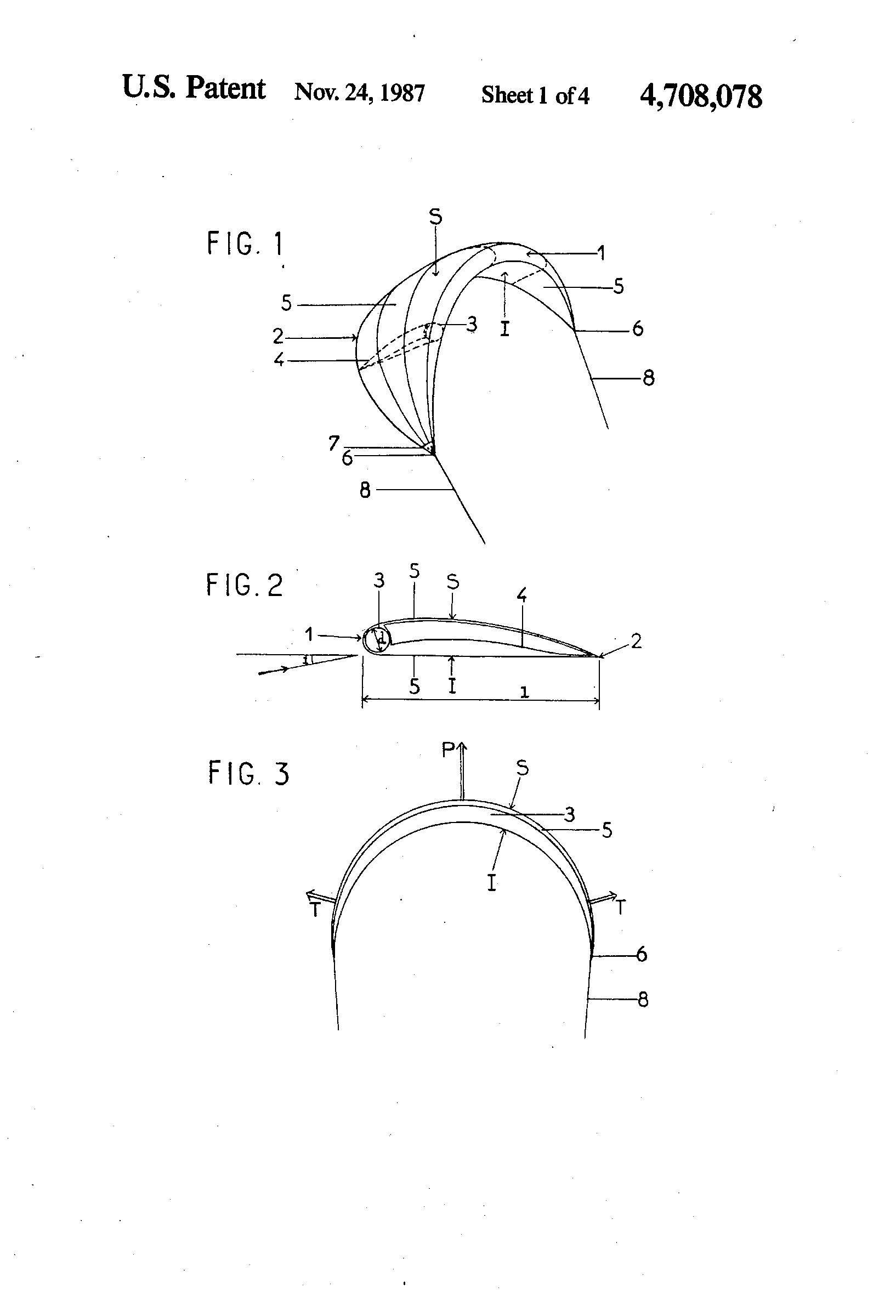
A wing that floats, 1984
The Legaignoux brothers gave the kite an inflatable leading edge: the tube in figure 2. A kite that crashes into the sea floats and can be relaunched from the water, which made kitesurfing possible. French filing in November 1984; the US patent came in 1987.
04 · adds the hydrofoil
The board leaves the water
2000–2015
Big-wave surfers bolted foils under strapped boards and flew over swell nobody could ride. Kiters and windsurfers followed. Meanwhile stand-up paddling came back from Waikiki, and paddlers began racing downwind across open-ocean channels, linking bumps instead of waiting for breaking waves.
- 2000–2002approximate
Four-line depower bars, safety releases and twin-tips
In the early 2000s, four-line kites with a chicken loop and trim allowed partial depower, and quick-release safety systems spread after 2002. Twin-tip boards took over flat water from about 2001, while directionals stayed in the surf.
correctedDoc groups '1997-2000s: inflatable kites + depower'. Meaningful depower arrived with four-line kites in the early 2000s, and near-full depower only with bow kites in 2005.
- 2000–2003approximate
Modern SUP revival by Hawaiian watermen
In the early 2000s Laird Hamilton, Dave Kalama, Brian Keaulana, Archie Kalepa and others took up paddle-surfing on big boards for training and fun. Magazine photos of Hamilton helped turn it into a new sport.
- 2003dated
Prone surf-hydrofoil patent filed
Tareah Hendricks filed a US patent (priority July 2003) for a self-launching prone hydrofoil paipo with a surface-piercing canard. It notes that the Hamilton-style towed foil boards needed outside power to get airborne.
- 2003first prototype
Starboard's first windsurf foil with Rush Randle
Starboard's foil history starts in 2003 with a solid aluminium windsurf foil prototype built with Hawaiian waterman Rush Randle. It remained experimental for about a decade.
correctedThis specific 2003 example supports the doc's vague '2000s wind foil experiments'.
- 2003went mainstream
Step Into Liquid puts foil surfing on screen
Dana Brown's documentary Step Into Liquid (released August 2003) included a hydrofoil segment of Laird Hamilton and Dave Kalama on Maui. For most viewers this was the first sight of surf foiling.
correctedThe doc says 2003 but names no film; the film is Step Into Liquid (Aug 2003). No source was found confirming foil footage in Riding Giants (2004).
- 2004–2005first on sale
Bow kite (Legaignoux): wide-range depower
The Legaignoux brothers patented a flat, swept kite with a concave trailing edge and bridled leading edge (priority 1 March 2004; US 7,374,133 filed Feb 2005, granted May 2008). They showed it to Takoon and Cabrinha in 2004, and the first bow kites went on sale in August 2005 (e.g. the Cabrinha Crossbow). These allowed near-total depower.
- 2004disputed
First SUP contest division (Buffalo Big Board, Makaha)
Brian Keaulana added a 'Beach Boy Surfing' stand-up division to the Buffalo Big Board Classic at Makaha. It is usually called the first official SUP contest.
correctedSources split between 2003 and 2004. Wikipedia and Hawaiian Paddle Sports say 2004.
- 2004–2008disputed
Carafino hydrofoil kiteboards
Maui's Manny 'Mango' Carafino built early hydrofoil boards for kite riding. By July 2007, Chip Wasson was racing a Carafino foil at the first US kiteboard nationals on SF Bay: much faster upwind, but slower downwind. French riders adopted Carafino foils for racing around 2008.
correctedThe doc says 2004, following Lift. Wikipedia gives a 2008 Fréjus introduction, and one aggregator claims 1999. The only contemporary source found (July 2007) confirms Carafino kite foils were racing by 2007.
- 2005–2007first on sale
First production SUP boards
From about 2005, dedicated SUP shapes appeared. Jimmy Lewis shaped prototypes for Hamilton, and Surftech's 'Laird' line followed, with boards of about 12 ft and 30 in or more. Touring and displacement hulls followed around 2007-08, and SUP spread to California and beyond.
- 2005–2006first recorded
Downwind SUP: stand-up paddlers cross the Molokai channel
The 32-mile Molokai-2-Oahu prone paddleboard race began in July 1997. Stand-up paddlers were crossing the Ka'iwi channel by 2005 (e.g. Andrea Moller), and a SUP division followed around 2006. This made open-ocean downwind runs a core SUP discipline.
correctedDoc dates SUP downwind to the '2010s'. Organised downwind SUP racing in Hawaii dates from about 2005-06. The 2006 division year comes from search snippets, not an official results page.
- 2008–2009first prototype
KTH Evolo electric hydrofoil (prior art)
A KTH (Stockholm) student project, Evolo, built and publicly documented an electric personal hydrofoil in 2008–09. Critics of Lift's patents later cited it as prior art.
- 2010–2014went mainstream
SUP goes mainstream
US SUP participation rose from about 1.1 million (2010) to 2.8 million (2014), according to the Outdoor Foundation. SUP was the fastest-growing outdoor activity of the period. The first dedicated magazine, Standup Journal, launched in 2007.
- 2011–2015first prototype
Logosz's inflatable Slingwing prototypes
Slingshot co-founder Tony Logosz made inflatable handheld wing prototypes around 2011–2012 and shelved them. He retried them on large foils around 2015 (a 2015 Hood River photo exists) and found he could foil upwind and downwind.
- 2015–2016first prototype
Aguera's thick high-lift foil for paddle-foiling
At Kai Lenny's request, Maui's Alex Aguera (GoFoil) reshaped his thin kite-foil wings into thicker, high-lift sections. These could fly at the slow speeds a paddler or a small swell can reach. GoFoil filed a provisional patent titled 'Stand Up Paddle (SUP) Foil Boards' in May 2016.
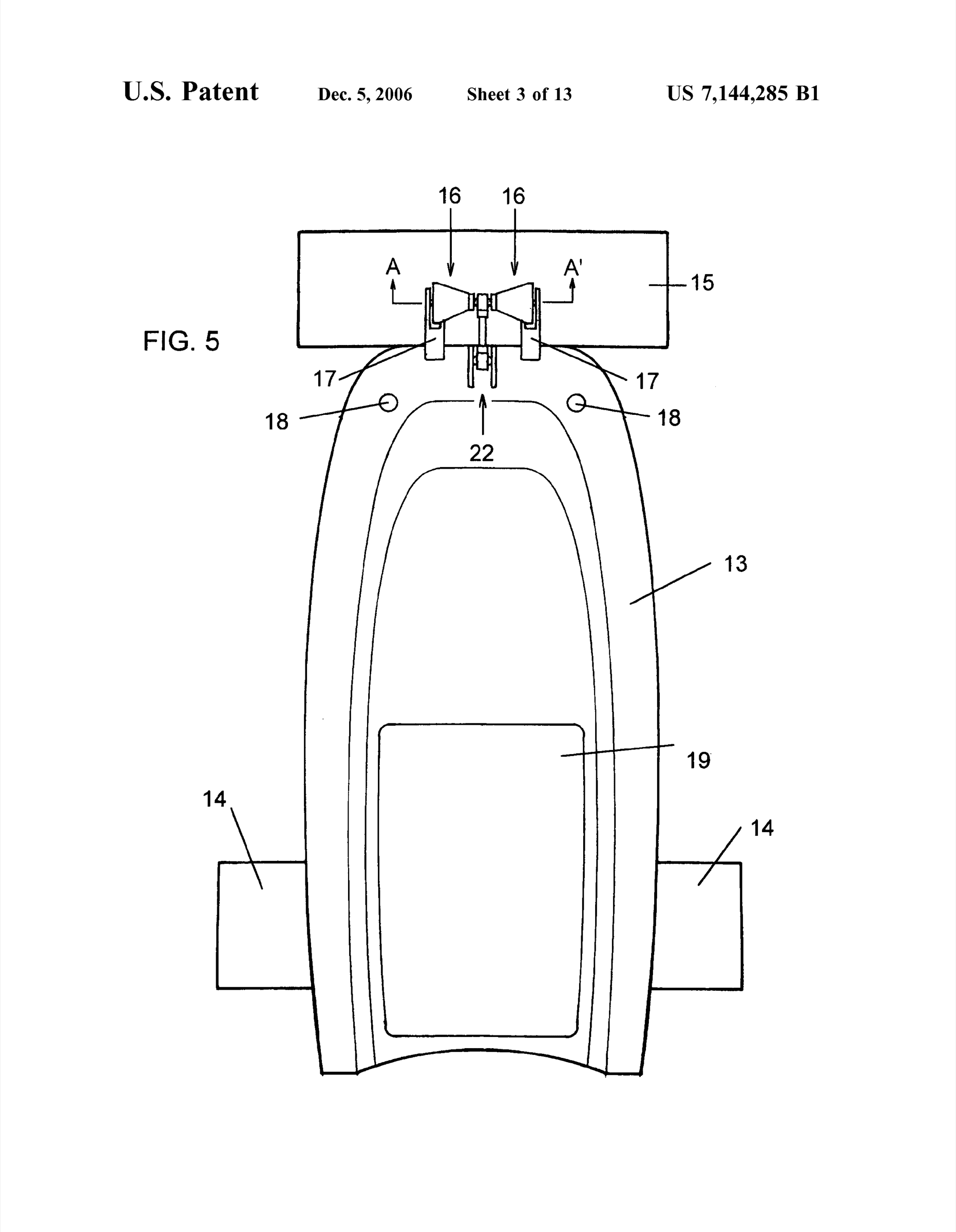
A foil board that launches itself, 2003
The first surf foils were towed: the rider needed a boat or a jet ski to get airborne. Tareah Hendricks’ patent describes a prone board with a rear wing and a small front canard, meant to take off from a wave alone. It says the tow boards needed outside power; this one would not.
05 · adds just enough power
Everything flies
2016–2021
Once the hull is out of the water it takes very little to keep it there. A paddle, an ocean bump, a battery or a wing held in two hands is enough. In five years the foil went from a stunt to the default, and boards started to shrink toward the least that will still get you up.
- 2016dated
First Formula Kite (foil) World Championships
The IKA's Formula Kite class, foil boards with RAM-air kites and registered production gear, held its first world championship in Weifang, China, in 2016.
- 2016dated
Kai Lenny downwind SUP foiling goes viral (Apr–May 2016)
In late April 2016, Kai Lenny posted himself foiling downwind on the Maliko run using only a paddle and swell. The board was a cut-down Naish 12'6 race board (about 3–3.2 m) on a GoFoil with an ~80 cm mast. The clip spread worldwide within days and launched paddle-powered foiling.
- 2016dated
Starboard race windfoil breakthrough (Aug 2016)
After foil concept work from 2012 by designer Tiesda You, Starboard reached a new racing foil geometry in August 2016. It went into production and led directly to the iQFOiL.
- 2017dated
GoFoil 'Hydrofoil-based apparatus' patent granted
US 9,789,935 (filed Feb 2017, issued Oct 2017), assigned to Go Foil Inc. with Alex Aguera as inventor, grew out of the May 2016 SUP-foil-board provisional.
correctedSome summaries present this patent as Lift's eFoil patent. It is GoFoil's (Aguera's). Lift's eFoil IP rests on licensed Langelaan (Penn State) patents.
- 2017–2018disputed
Lift eFoil: announced 2017, delivered 2018
Puerto Rico's Lift Foils (founded 2011 by Nick Leason) announced the first commercial electric hydrofoil board in July 2017: 2 kWh battery, 22 kn, $12,000, deliveries planned for September 2017. In later interviews Leason says the first commercial eFoil reached customers in 2018, about a year late. Lift holds an exclusive license to Penn State Prof. Langelaan's weight-shift hydrofoil patents.
correctedThe doc says 'commercial eFoil 2017', which is when it was announced and pre-sold. Leason's own interviews give 2018 as the first commercial launch.
- 2017–2018first on sale
Production SUP foil boards appear
Brands began selling short, wide SUP foil boards, such as Starboard's 2017 Hypernut Foil (7'4 x 30 in, 106 L) and Naish's MY2019 Hover SUP range (announced September 2018). These boards are much shorter than race SUPs but still very wide for stability.
- 2018–2019approximate
Dock-start pump foiling emerges
Around 2018, flat-water riders began launching foils from docks, first with bungee or winch assists and then by jumping on and pumping, as large low-speed pump wings arrived.
- 2018dated
Flash Austin wing-foils a SUP foil board on Maui (Mar–Apr 2018)
In March–April 2018, Maui kiter Flash Austin was filmed foiling on a SUP foil board with a handheld wing (a 4 m 'Windweapon'; Ken Winner recalls a framed wing). The clip convinced Ken Winner to build an inflatable version.
- 2018–2021dated
Kite foiling chosen for the Olympics
World Sailing's AGM on 4 November 2018 confirmed a mixed kiteboarding relay using Formula Kite foil equipment for Paris 2024. In 2021 it was changed to separate men's and women's events.
- 2018first prototype
Ken Winner's first inflatable wing (June 2018)
Ken Winner tested his first home-built inflatable handheld wing in June 2018. He showed it to Duotone's Till Eberle that autumn, and Naish and F-One had prototypes by late 2018.
- 2019first on sale
First production inflatable wings (spring–summer 2019)
Several brands launched within months of each other. Duotone's Ken Winner 'Foil Wing' (2–5 m², solid boom, window) was marketed from spring 2019. Naish's 4 m² Wing-Surfer was announced on 23 May 2019, F-One's Swing launched in July 2019, and Slingshot's SlingWing was on sale by mid-2019. No single brand can clearly claim first.
correctedThe 2019 Duotone product was the 'Foil Wing'; the 'Slick' name came later. The Naish 'Wing-Surfer' (2019) is correct.
- 2019first on sale
First dedicated wing-foil boards
By September 2019, F-One listed the Rocket Wing, one of the first board ranges designed for wing foiling. Sizes ran from 5'0 x 22 in (57 L) to 5'10 x 25 in (90 L), much shorter than the SUP foil boards riders had used before. Tonic notes the sport took off once big foils (>1800 cm²) became common.
- 2019dated
iQFOiL replaces RS:X as Olympic windsurfer (Nov 2019)
After sea trials at Torbole in October 2019, World Sailing picked Starboard's iQFOiL windfoil (220 x 95 cm board) in November 2019, replacing the fin-driven NeilPryde RS:X used since 2008.
- 2020–2021approximate
Longer, still-wide SUP foil boards for downwinding
Before dedicated narrow DW boards, downwinders used longer SUP foil boards that were still wide. James Casey's early Sunova Aviator (archived February 2021) ran from 5'10 x 26 in to 6'10 x 32 in, and Dave Kalama was shaping his own DW foil boards on Maui.
- 2021dated
First GWA Wingfoil World Tour event (Leucate, Apr 2021)
The Global Wingsports Association's professional wingfoil tour opened at the Mondial du Vent, Leucate, in late April 2021, with surf-freestyle and surf-race divisions and 52 riders.
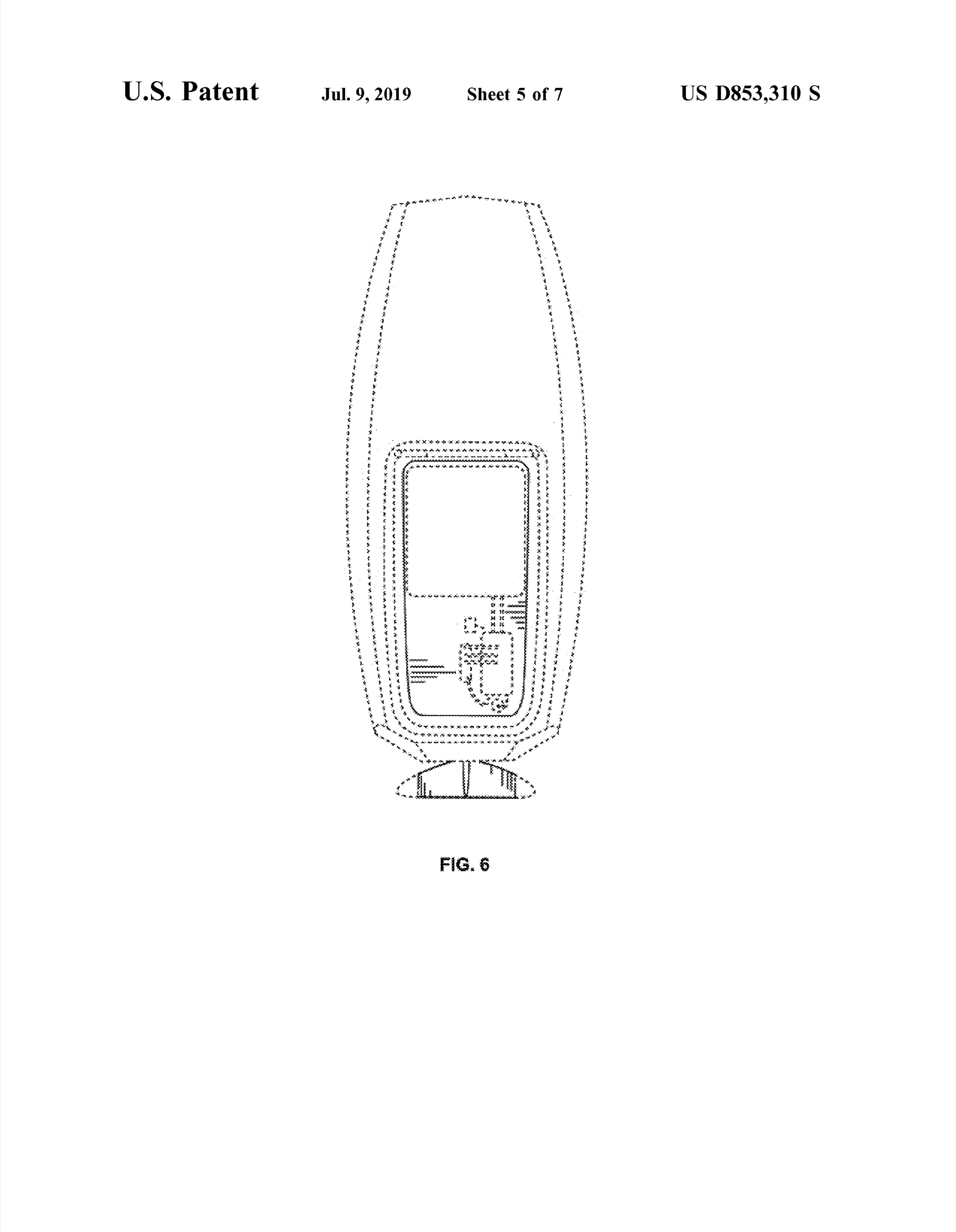
The eFoil from above, 2018
Lift Foils announced the first commercial electric foil board in July 2017; buyers got theirs in 2018. The design patent’s top view shows the battery bay taking up most of the deck. The traced outline, scaled to the E1’s published 168 × 71 cm, sits below at the atlas’s scale.
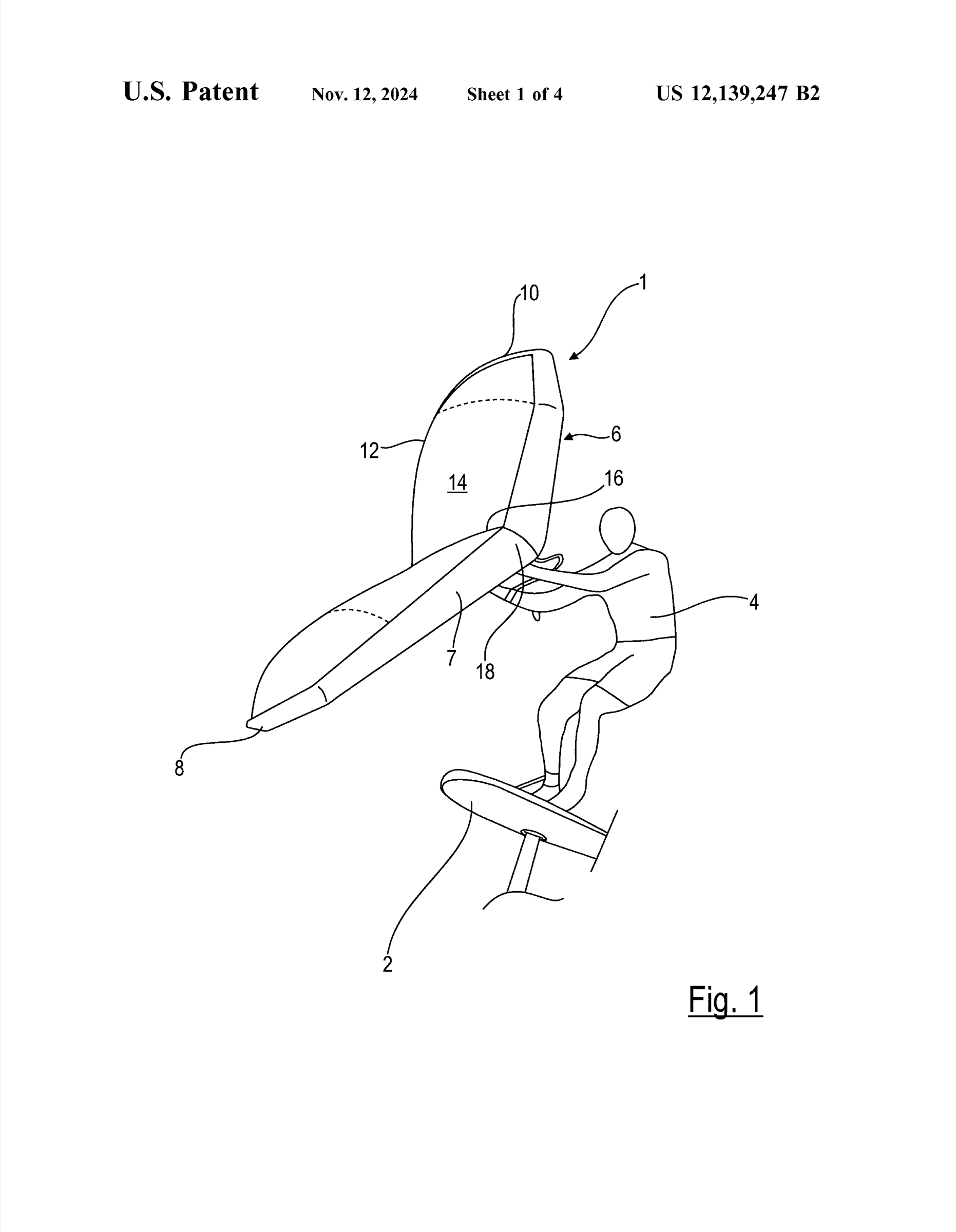
A wing held in two hands
Ken Winner tested his first home-built inflatable wing in June 2018 and took it to Duotone. In spring and summer 2019 Duotone, Naish, F-One and Slingshot all put wings on sale, within months of each other. The same idea as Drake’s 1981 hand sail, now light enough, over a board that no longer drags.
06 · adds temporary propulsion
Power you can put away
2022–now
Downwind boards became long, narrow and light, built to take off on the smallest bump. Then the wing shrank into something you can stow mid-run: the parawing pulls you onto the foil, gets packed away, and you glide on the swell alone.
Armstrong Downwind Mk II (Downwind FG) 106 L, side line traced, at the same true scale as its rider (1.78 m). Wing ~4 m² on 1.4 m lines, flown low in front with the bar held fore–aft; foil schematic, 85 cm mast.
- 2022first on sale
Dedicated narrow downwind foil boards
By 2022, production boards built for downwind SUP foiling appeared. F-One's Rocket SUP Downwind was 23.5–27.8 in wide, and Sunova's Aviator Downwind Elite (October 2022) was 20–22.5 in. KT and Kalama followed similar ideas, and Kai Lenny showed the new generation on the Maliko run in August 2022.
- 2022–2025dated
Pump-foil endurance records
In September 2022, Keaton Fischer pumped for 23 min (6.15 km) on an AXIS PNG1310, beating a previous record of about 17 min. By May 2024, Nicolas Iten had pumped more than 39 km in 2 h 39 on a 72 cm mast, and later extended the record to 54.8 km. Organised pump-foil contests (Berlin, 2024) and a World Cup (2025) followed.
- 2023first on sale
Armstrong DW board: 19.5–21 in widths go mainstream
In early 2023 Armstrong released its Downwind board, e.g. 7'2 x 19.5 in (96 L) and 7'7 x 21 in (121 L), sized for its high-aspect foils. It became a benchmark for the category.
- 2023first prototype
Pocket Wing: stowable parachute-style wing for downwinding
On Maui's North Shore around 2023, Sam Reynolds of Five-O Windsports made small parachute-style 'pocket wings' to get onto a downwind foil and then stow. Cynthia 'Cynbad' Brown experimented with model-rocket parachutes. Five-O sold the Pocket Wing before the word 'parawing' existed, though V1 went upwind poorly.
correctedThe doc lists Tony Logosz as a parawing pioneer, but no source found supports this.
- 2024first on sale
BRM Maliko: first upwind-capable parawing (Aug 2024)
Greg Drexler of Boardriding Maui released the Maliko in August 2024 (IKSURFMAG news, 23 Aug 2024). It is a single-skin parafoil with a short vertical control bar that can go upwind, then be stowed on a belt for gliding. It is widely credited with starting the parawing category.
- 2024dated
Foiling's Olympic debut at Paris 2024 (Marseille)
Windsurfing moved to the iQFOiL (golds: Tom Reuveny ISR, Marta Maggetti ITA). Kiteboarding debuted as Formula Kite, 4–9 August (golds: Valentin Bontus AUT, Ellie Aldridge GBR). These were the first Olympic medals won on hydrofoil boards.
- 2025first on sale
Ultra-narrow, long DW boards (≤17 in)
By 2025, DW boards had become longer and narrower still. Sunova's 2025 Aviator Downwind line has 24 sizes, down to 8'8 x 16.5 in. Mid-length 'crossover' wing/DW boards (e.g. Naish Hover Downwind Crossover, 6'8 x 23 in) filled the space between.
- 2025–2026went mainstream
Parawings go multi-brand
Within months many major brands shipped parawings: Flow D-Wing (January 2025), Ozone Pocket Rocket (announced January, sizes 1.9–5 m by March 2025), Duotone STASH by Ken Winner (about April 2025) and Naish Morph (April 2025). F-One, North, Gong, Flysurfer, Takoon, Triple Seven and Sabfoil followed. Foil Exchange counted about 26 models from about 20 brands by October 2025, and BRM had a second generation in 2025.
Same scale, 250 years apart
Historic boards next to boards in the catalogue, tails on one line. Solid boards are traced outlines; a dashed box is a board we only know by its length and width.
Sources
Numbered in the order the page first cites them. Tier 1 is primary: patents, museums, class associations, magazines written at the time. Tier 4 is general reference, used to find the others. A source marked “found” turned up in searches but was not opened for this page.
- [1]
James King on Hawaiian surfing: 1779 account from Cook's final voyage
Encyclopedia of Surfing (Matt Warshaw) · tier 2 · encyclopedia
- [2]
First European written account of Hawaiian surfing
Museum of British Surfing · tier 1 · museum
- [3]
Encyclopedia of Surfing · tier 2 · encyclopedia
- [4]
Encyclopedia of Surfing · tier 2 · encyclopedia
- [5]
1830 Chief Paki's Olo 15ft 7in
surfresearch.com.au (Geoff Cater) · tier 2 · museum
- [6]
Ancient Hawaiian boards - Bishop Museum collection (Blake/Buck)
surfresearch.com.au · tier 2 · book
- [7]
US1112405A Hydroflying-machine (E. Forlanini)
Google Patents / USPTO, 1905-04-06 filed; 1914-09-29 granted · tier 1 · patent
- [8]
Musée de la Plaisance (Boating museum), n.d. · tier 1 · museum
- [9]
A Complete History and Guide to Hydrofoil Surfing
Lift Foils (Nick Leason), 2020-01-06 · tier 3 · manufacturer
- [10]
USA Water Ski & Wake Sports, n.d. · tier 2 · association
- [11]
The Canadian Encyclopedia, accessed 2026-09 · tier 3 · encyclopedia
- [12]
Wikipedia, accessed 2026-09 · tier 3 · encyclopedia
- [13]
Swimming at the 1912 Summer Olympics - Men's 100 metre freestyle
Wikipedia · tier 4 · olympic
- [14]
Duke Kahanamoku wins gold medal in swimming
Bishop Museum Blog · tier 1 · museum
- [15]
Duke Kahanamoku - Blue Plaques
NSW Environment and Heritage · tier 1 · museum
- [16]
Duke Kahanamoku's Australian Tour, 1914-1915
surfresearch.com.au · tier 2 · magazine
- [17]
For Posterity's Sake (Canadian naval heritage site), n.d. · tier 3 · museum
- [18]
Culture - Alexander Graham Bell National Historic Site
Parks Canada, n.d. · tier 1 · museum · found
- [19]
Tom Blake - National Inventors Hall of Fame inductee
National Inventors Hall of Fame · tier 1 · museum
- [20]
The History of Surfboard Design: Tom Blake's 'Cigar Box'
Surf Simply · tier 3 · magazine
- [21]
US 1,872,230 Water Sled (Thomas E. Blake)
USPTO via Google Patents, 1932-08-16 · tier 1 · patent
- [22]
Wikipedia · tier 4 · encyclopedia
- [23]
Defining moments in SUP part 1 - History of SUP
SUPboarder Magazine, 2013-09-28 · tier 2 · magazine
- [24]
Hawaiian Paddle Sports · tier 3 · manufacturer
- [25]
The History of Surfboard Design: Bob Simmons' Planing Hull ('The Spoon')
Surf Simply · tier 3 · magazine
- [26]
Who Invented the Foam Surfboard
California Surf Museum · tier 1 · museum
- [27]
International Windsurfer Class Association · tier 1 · association
- [28]
Wikipedia · tier 4 · encyclopedia
- [29]
From the sea to IP: how windsurfing changed UK patent law
GJE (patent attorneys) · tier 2 · court
- [30]
Wikipedia · tier 4 · encyclopedia
- [31]
US3164119A Hydrofoil lift (Emmanuel & Woodward, assignee Cosmo Dynamics)
Google Patents / USPTO, priority 1963-03-26; granted 1965 · tier 1 · patent
- [32]
Adventures in Water Skiing, Hydrofoiling: Stand Up Foils
A Water Skier's Life (Tony Klarich), 2014 (text) · tier 3 · magazine
- [33]
American Windsurfer · tier 2 · magazine
- [34]
Darby Industries, Inc. · tier 2 · manufacturer
- [35]
Archive find: the birth of windsurfing - an article from 1965
SURF (Germany) · tier 2 · magazine
- [36]
Windsurfing Museum Prague · tier 1 · museum
- [37]
Origins of Windsurfing: Jim Drake (interview)
American Windsurfer · tier 2 · interview
- [38]
International Windsurfing Association · tier 2 · association
- [39]
Encyclopedia of Surfing · tier 2 · encyclopedia
- [40]
The History of Surfboard Design: Bob McTavish and the Vee Bottom
Surf Simply · tier 3 · magazine · found
- [41]
US 3,487,800 Wind-propelled apparatus (Schweitzer & Drake)
USPTO via Google Patents, 1970-01-06 · tier 1 · patent
- [42]
US RE31,167 Wind-propelled apparatus (reissue)
FreePatentsOnline, 1983-03-08 · tier 1 · patent
- [43]
Windsurfing International v. AMF, 828 F.2d 755 (Fed. Cir. 1987)
Justia, 1987 · tier 1 · court · found
- [44]
Tinkering, Vision, Business and Patents: the tangled history of windsurfing
Rick Sanders Law · tier 3 · court
- [45]
The foil windsurfing experience in the 1970s and 1980s
SurferToday, n.d. · tier 2 · magazine · found
- [46]
The Imperfect History of the Surf Leash
World Surf League · tier 2 · magazine
- [47]
Wikipedia · tier 4 · encyclopedia
- [48]
Hoyle and Diane Schweitzer - inductee
National Sailing Hall of Fame / The Sailing Museum · tier 1 · museum
- [49]
The thrilling story of the Original Windsurfer
Surfertoday · tier 3 · magazine · found
- [50]
International Windsurfer Class Association · tier 1 · association
- [51]
Wikipedia · tier 4 · encyclopedia
- [52]
The Windsurfing Hall of Fame · tier 2 · association
- [53]
Simon Anderson and the Thruster, 1981
surfresearch.com.au · tier 2 · magazine
- [54]
US 4,563,969 Sail having variable propelling and lifting effects (Roland Le Bail) - Bird Sail
FreePatentsOnline, 1986-01-14 · tier 1 · patent
- [55]
Windsurfing Museum Prague · tier 1 · museum
- [56]
ION CLUB · tier 3 · manufacturer
- [57]
US 4,651,665 Hand sail (James R. Drake)
USPTO via Google Patents, 1987-03-24 · tier 1 · patent
- [58]
ATE28433T1 Handsegel (James R. Drake) - family DE3140685, EP0076954
Google Patents, 1981-10-13 · tier 1 · patent
- [59]
Wikipedia · tier 4 · encyclopedia
- [60]
The story of Jim Drake's first 'Wing' rig
SurferToday, n.d. · tier 2 · magazine · found
- [61]
Windsurfing International Inc. v Tabur Marine (Great Britain) Ltd [1984] EWCA Civ J0131-3
vLex (Court of Appeal judgment), 1984-01-31 · tier 1 · court
- [62]
NextFoils (Mike Murphy), n.d. · tier 2 · interview
- [63]
Adventures in Water Skiing, Hydrofoiling: Air Chair
A Water Skier's Life (Tony Klarich), 2017-06-10 · tier 2 · interview
- [64]
Wikipedia, accessed 2026-09 · tier 3 · encyclopedia
- [65]
US 4,708,078 Propulsive wing with inflatable armature (Legaignoux)
USPTO via Google Patents, 1987-11-24 · tier 1 · patent
- [66]
The WIPIKA History (chapter II)
kiteboardhistory.com (Legaignoux archive) · tier 2 · manufacturer
- [67]
100 Moments: A Kitesurfing Timeline (issue 100)
IKSURFMAG · tier 2 · magazine
- [68]
Windsurfer (Windglider), Men - 1984 Los Angeles
Olympedia, 1984 · tier 1 · olympic
- [69]
Retracing Roots - Los Angeles 1984 Olympic Sailing Competition
World Sailing, 2012-05-30 · tier 1 · association
- [70]
Wikipedia · tier 4 · encyclopedia
- [71]
US 4,682,557 Sailing wing (Magruder & Crowell) - Wind Weapon
USPTO via Google Patents, 1987-07-28 · tier 1 · patent
- [72]
WO 87/03553 Sailing wing (Magruder & Crowell)
WIPO via Google Patents, 1987-06-18 · tier 1 · patent
- [73]
Is the 'Wind Weapon' the mother of wingsurfing?
SURF (Germany) · tier 2 · magazine
- [74]
Tonic Mag (Issue 6), 2020-11-08 · tier 2 · magazine
- [75]
Wingfoil history: Duotone designer Ken Winner - how it all began
SURF (Germany) · tier 2 · magazine
- [76]
Wikipedia · tier 4 · encyclopedia
- [77]
US5249998A Water sports device (Woolley & Murphy)
Google Patents / USPTO, priority 1989-02-23; filed 1991-10-16; granted 1993-10-05 · tier 1 · patent
- [78]
US 5,366,182 Kiteski (W. G. & C. Roeseler)
FreePatentsOnline, 1994-11-22 · tier 1 · patent
- [79]
Roots of Kiteboarding next in Sense of Place series
Columbia Gorge News · tier 3 · magazine · found
- [80]
Wikipedia · tier 4 · encyclopedia
- [81]
Kitesurfing Handbook - History of kitesurfing
Peter's Kiteboarding · tier 3 · magazine
- [82]
Wikipedia, accessed 2026-09 · tier 3 · encyclopedia
- [83]
Wikipedia · tier 4 · encyclopedia
- [84]
US7144285B1 Hydrofoil surfing board (T. J. Hendricks)
Google Patents / USPTO, priority 2003-07-15; granted 2006-12-05 · tier 1 · patent
- [85]
IKSURFMAG · tier 2 · magazine
- [86]
kiteboardhistory.com, 1998 · tier 2 · manufacturer
- [87]
More about Kitesurf (Wipika 1998-99)
kiteboardhistory.com, 1998 · tier 2 · manufacturer
- [88]
Industry Insight: Control Bars (issue 69)
IKSURFMAG · tier 2 · magazine
- [89]
Encyclopedia of Surfing · tier 2 · encyclopedia
- [90]
Windsurf Magazine (UK), c.2020 · tier 2 · magazine
- [91]
Wikipedia, accessed 2026-09 · tier 3 · encyclopedia
- [92]
Laird, You Promised Hydrofoils
SURFER Magazine, n.d. · tier 2 · magazine · found
- [93]
US 7,374,133 Wing having a negative dihedron for towing a load (bow kite)
FreePatentsOnline, 2008-05-20 · tier 1 · patent
- [94]
Wikipedia · tier 4 · encyclopedia
- [95]
Air. It's Not Just for Breathing, Anymore
SAIL WEST (Sail magazine blog), 2007-07-28 · tier 2 · magazine
- [96]
Surftech SUP Laird 12'1" specs
Lake George Kayak Co. (retailer) · tier 3 · manufacturer
- [97]
Wikipedia · tier 4 · encyclopedia · found
- [98]
Molokai 2 Oahu Paddleboard World Championships · tier 1 · association
- [99]
Wikipedia · tier 4 · encyclopedia
- [100]
Is a questionable patent slowing down the e-Foil trend?
E-Surfer, n.d. · tier 3 · magazine
- [101]
Special Report on Paddlesports 2015
Outdoor Foundation / Coleman, 2015 · tier 1 · association
- [102]
The second life of the Slingwing
SurferToday, n.d. · tier 2 · magazine · found
- [103]
Go Foil with Alex Aguera / Past, present & future
SUPboarder Magazine, 2019-09-20 · tier 2 · interview
- [104]
US 9,789,935 Hydrofoil-based apparatus (Go Foil, Inc.)
Justia Patents, filed 2017-02-13; issued 2017-10-17 · tier 1 · patent · found
- [105]
Wikipedia, accessed 2026-09 · tier 3 · encyclopedia
- [106]
Kai Lenny Pushes the Boundaries by Unveiling New Hydrofoil Race Board
SUP Racer, 2016-04-29 · tier 2 · magazine
- [107]
Kai Lenny SUP Downwind Hydro Foiling
IKSURFMAG, 2016-05-01 · tier 2 · magazine
- [108]
Hydrofoil SUP – Kai Lenny's Board Explained
TotalSUP, 2016-05-04 · tier 2 · magazine
- [109]
The past, present and the future - SUP Hydro Foils
SUPboarder Magazine, 2016-05-10 · tier 2 · magazine
- [110]
Lift Foils $12,000, 25 mph electric hydrofoil surfboard set to launch in September
New Atlas, 2017-07-12 · tier 2 · magazine
- [111]
Nick Leason's 10-year Journey to Create the Electric Surfboard
C-Suite Quarterly, 2022-08 · tier 2 · interview
- [112]
NICK LEASON - Lift Foils - Interview
E-Surfer, 2017 interview · tier 2 · interview
- [113]
Hyper Nut Foil Board 7'4 x 30 Blue Carbon (2017)
SUPboarder Magazine equipment guide, 2017 · tier 2 · magazine
- [114]
2019 Naish Hover SUP | SUP Foilboards
Naish, 2018-09-07 · tier 1 · manufacturer
- [115]
What Is the Sport of Pump Foiling All About?
Foiling Freaks, n.d. · tier 3 · magazine
- [116]
Strapless Kitesurfing (video blog), 2018-04-17 · tier 3 · video
- [117]
World Sailing AGM confirms Kiteboarding for the Paris 2024 Olympic Games
Sail-World (World Sailing release), 2018-11-04 · tier 2 · olympic
- [118]
Duotone take on the Wing Surfer with the Foil Wing
SUPboarder Magazine, 2019-06-12 · tier 2 · magazine
- [119]
Naish Kiteboarding – Wing-Surfer is now LIVE!
IKSURFMAG, 2019-05-23 · tier 2 · magazine
- [120]
F-ONE, 2019 · tier 1 · manufacturer · found
- [121]
ROCKET WING (product page, archived 23 Sep 2019)
F-ONE via Internet Archive, 2019-09-23 · tier 1 · manufacturer
- [122]
2020 F-One Rocket Wing V1 Foil Board - TKB review
MACkite, 2020-04-20 · tier 3 · magazine
- [123]
Starboard, current · tier 1 · manufacturer
- [124]
Aviator (Casey), archived 28 Feb 2021
SUNOVA via Internet Archive, 2021-02-28 · tier 1 · manufacturer
- [125]
SUP Downwind Foiling Evolution
Stand Up Magazin, 2022-08 · tier 2 · magazine
- [126]
GWA Wingfoil World Cup Leucate 2021 - Day 1
Sail-World, 2021-04-29 · tier 2 · magazine
- [127]
F-One Rocket SUP Downwind 6'2, 105L 2022
Tonic Mag, 2022 · tier 2 · magazine
- [128]
Aviator Downwind Elite (Casey), archived 7 Oct 2022
SUNOVA via Internet Archive, 2022-10-07 · tier 1 · manufacturer
- [129]
Stand Up Magazin, 2022-09 · tier 2 · magazine
- [130]
Indiana Paddle & Surf, 2024-05-13 · tier 3 · manufacturer
- [131]
ARMSTRONG FOILS DOWNWIND BOARD | 68 x 19.5 x 5 5/8 – 96L
Tonic Mag, 2023-03-10 · tier 2 · magazine
- [132]
Armstrong Foils, discontinued (2023 gen) · tier 1 · manufacturer
- [133]
Armstrong Foils Downwind SUP 7'7, 21 2023
Tonic Mag, 2023-07-24 · tier 2 · magazine · found
- [134]
Foiling Magazine, n.d. · tier 2 · magazine
- [135]
Parawinging Maui: The Ultimate Guide
Kite HI (Maui school), n.d. · tier 3 · magazine
- [136]
New Sensation: Exploring the Birth of the Parawing
Foiling Magazine (Bowen Dwelle), c.2025 · tier 2 · magazine
- [137]
Five-O Windsports, current · tier 3 · manufacturer
- [138]
Foil Exchange, 2025-10-08 · tier 3 · magazine
- [139]
IKSURFMAG, 2024-08-23 · tier 2 · magazine
- [140]
Boardriding Maui, current · tier 3 · manufacturer
- [141]
What is a Formula Kite in Olympic sailing?
World Sailing (Paris 2024 site), 2024-07-18 · tier 1 · olympic
- [142]
Marta Maggetti and Tom Reuveny win gold in new windsurfing class at Paris Olympics
AP via Daily Union, 2024-08-03 · tier 2 · olympic · found
- [143]
SUNOVA, 2025 · tier 1 · manufacturer
- [144]
Mid-length wingboard: The Naish Hover Downwind Crossover in test
SURF magazin, 2025-01-20 · tier 2 · magazine
- [145]
IKSURFMAG, 2025-03-14 · tier 2 · magazine
- [146]
Duotone release the new STASH Parawing
Foiling Magazine, 2025 · tier 2 · magazine
- [147]
Greensliding (alaia history blog), 2013-01 · tier 3 · museum
- [148]
Old school, new school - Windsurfer LT One Design test
Windsurfing UK · tier 2 · magazine
The research this page started from is kept in the repository as docs/history/surf_wind_foiling_evolution_research.md; where the sources disagreed with it, the event says so. Images are public domain or openly licensed, credited under each.